Today, I return to my writing roots. My writing journey began in earnest in 2016, when I started sending missives to family and friends about my travels. I decided a travel blog post might offer a welcome change of pace for my dear readers.
I will limit my comments to those you do not find in textbooks or travel guides, or if present, are addressed inadequately because they lack my anthropological perspective.
Misconceptions and Surprises
You are probably familiar with the Galapagos, a chain of volcanic islands in the Pacific Ocean, 550 miles from mainland Ecuador. Charles Darwin made them famous by using his wildlife observations in the 1830s to develop evolutionary theories.
Given the typical scenery publicized, one would expect an unpopulated archipelago barely touched by humankind. In reality, there are more than 30,000 permanent residents and two airports that can accommodate 737 jets. However, almost all of the islands are uninhabited, with only brief forays by tourists ferried there by Zodiacs from their <100-passenger cruise ships.
Graffiti. Despite the absence of people, familiar white splotches left by urban graffiti artists appear on rock faces throughout the islands. Upon closer inspection, I discovered the splotches are the remnants of millions of bird bowel movements. I did find real graffiti messages in Tagus Cove on Isabella Island left by whalers, pirates, and explorers as a form of communication equivalent to “Richard was here.”
0o latitude. The equator runs through the Galapagos and divides the day into equal measures of sunlight and darkness throughout the year. There are two seasons, wet and dry, with little temperature variation.
Survival of the fittest? Not so fast. Most people use this catchphrase to describe Darwin’s theory of evolution, but it actually comes from another scientist who unartfully paraphrased Darwin’s ideas. Later scientists “corrected” the statement to – “It is not the strongest…nor the most intelligent…it is the one most adaptable to change.” But there is no evidence that Darwin said this either. At the risk of further inaccuracy, Darwin meant that the best-suited survive, and that strength and adaptability are the crucial factors.
A Twist of Fate?
Charles Darwin is to the Galapagos what Robert H. Jackson is to the historical picture.
You have likely seen Jackson’s Pulitzer Prize-winning photo of JFK’s assassin, Lee Harvey Oswald, wincing as the bullet fired by Jack Ruby entered his abdomen. The picture appears in every news story, textbook, and encyclopedia (pre-Wikipedia) about Lee Harvey Oswald. You probably have not seen the photo Robert Beers snapped half a second earlier. By triggering the shutter earlier, Beers missed the wince, and the photo remained in obscurity.
During the same period Darwin was in the Galapagos, Alfred Russel Wallace was conducting identical research in the Malay Archipelago. They independently developed remarkably similar theories, shared information, and jointly published a scientific paper. Why aren’t Wallace and the Malay Archipelago mentioned in the same breath as Darwin and the Galapagos? Darwin published On the Origin of Species, which propelled him to fame, while Wallace took a less promotional path.
Stories like this one turn our minds to the times we missed out on a grand accomplishment because fortune did not favor us (that could have been me!). But if we gave equal consideration to the fortuitous events that gave rise to our greatest joys (the chance introduction to our significant other), we might find the scales tipped in our favor, or at least balanced. Sorry, I had to inject a 52 Steps Forward perspective.
The Wildlife
One overarching observation is how unafraid the wildlife is of humans. Visitors are asked to stay six feet away, but one cannot avoid getting closer because of the animals’ intrusion onto or proximity to the footpaths.
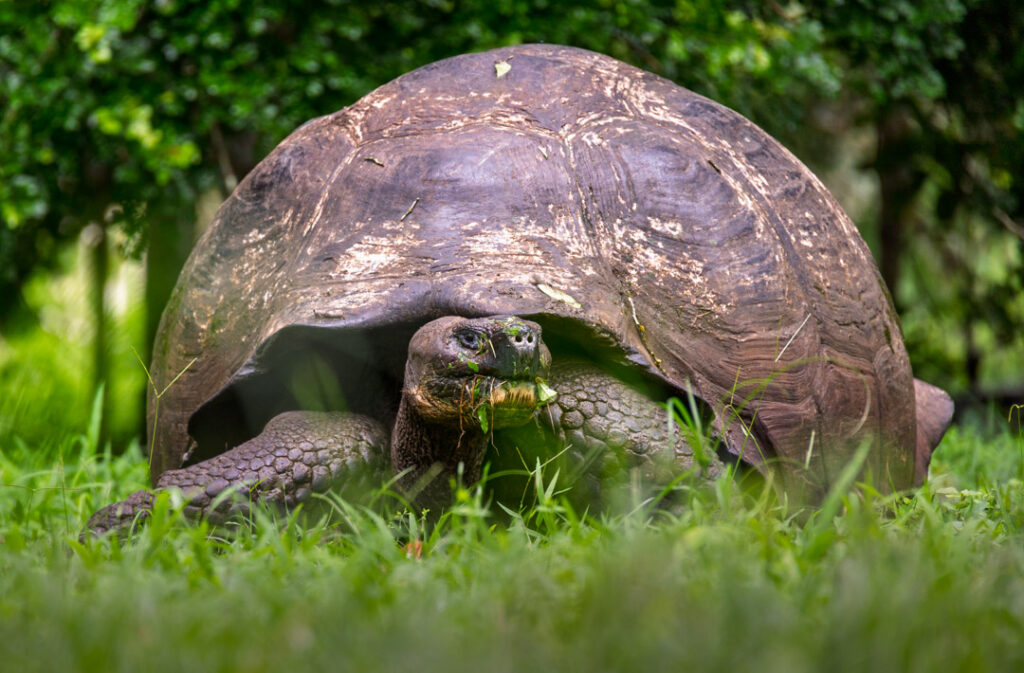
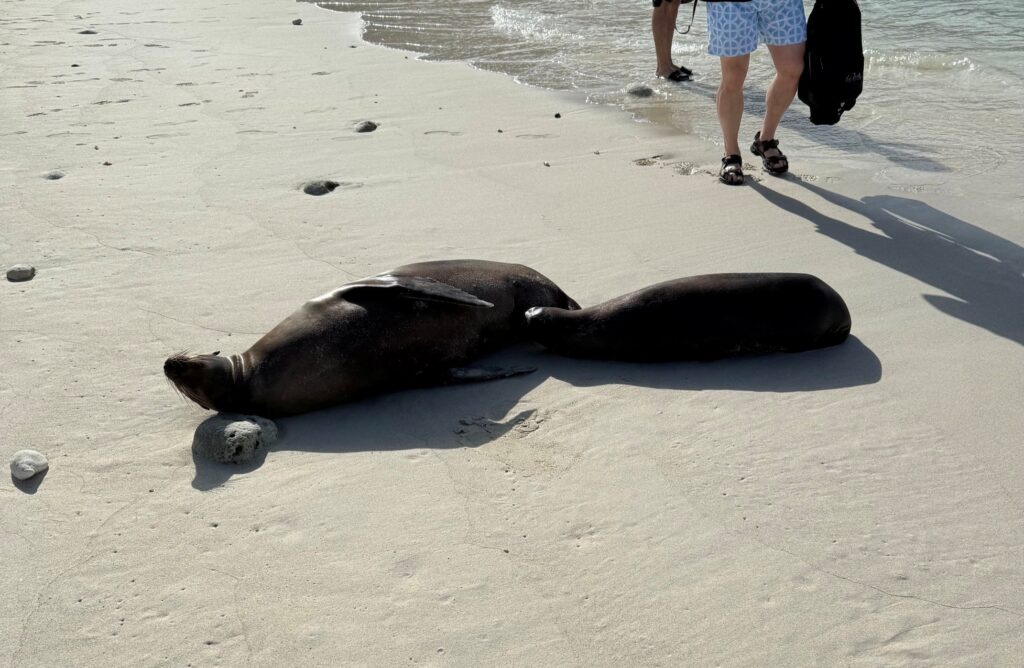
Land. Any visit to the Galapagos must include seeing the enormous, long-lived tortoises. While not as tall, they are almost as large as a Volkswagen Beetle and can live up to 175 years. They lazily tear at the grass while tourists gather around for a photo op.
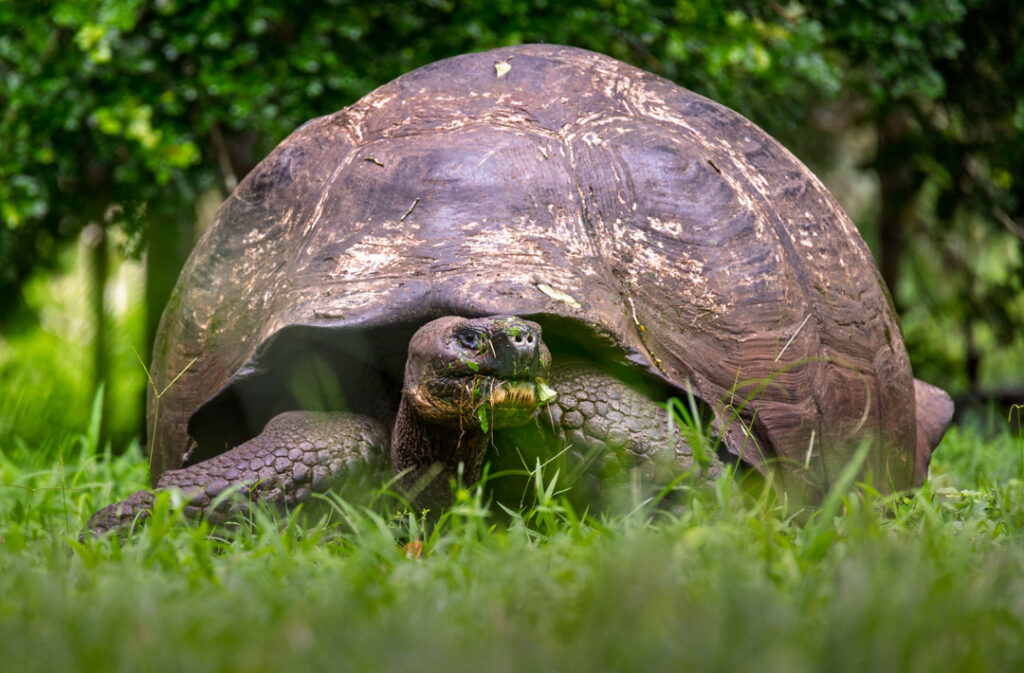
Countless palm-sized, agile Sally Lightfoot crabs scramble over the rocks along the shore. I suspect there has not been such a concentration of crabs since a boatload of sailors returned from shore leave after a six-month tour of duty.
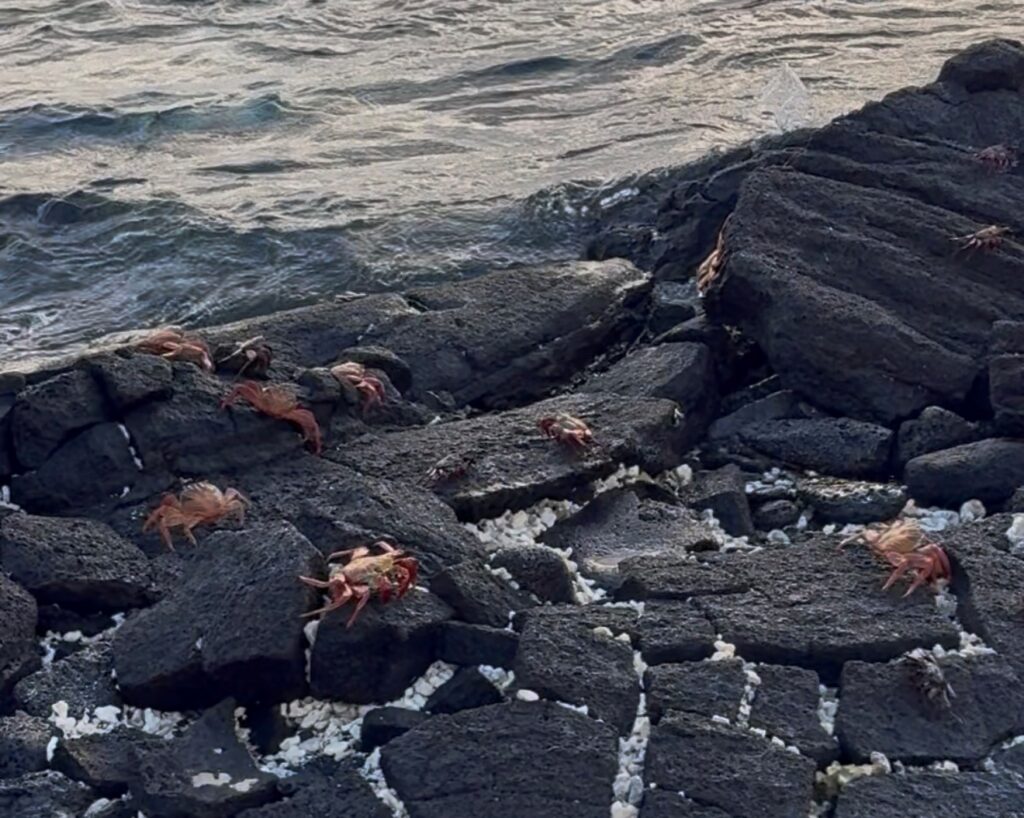
Sea. Sea lions, distinguishable from seals by their ear flaps, lounge on beaches and do not move a muscle (even those with pups suckling) when tourists storm the beach like marauding invaders to snap photos.
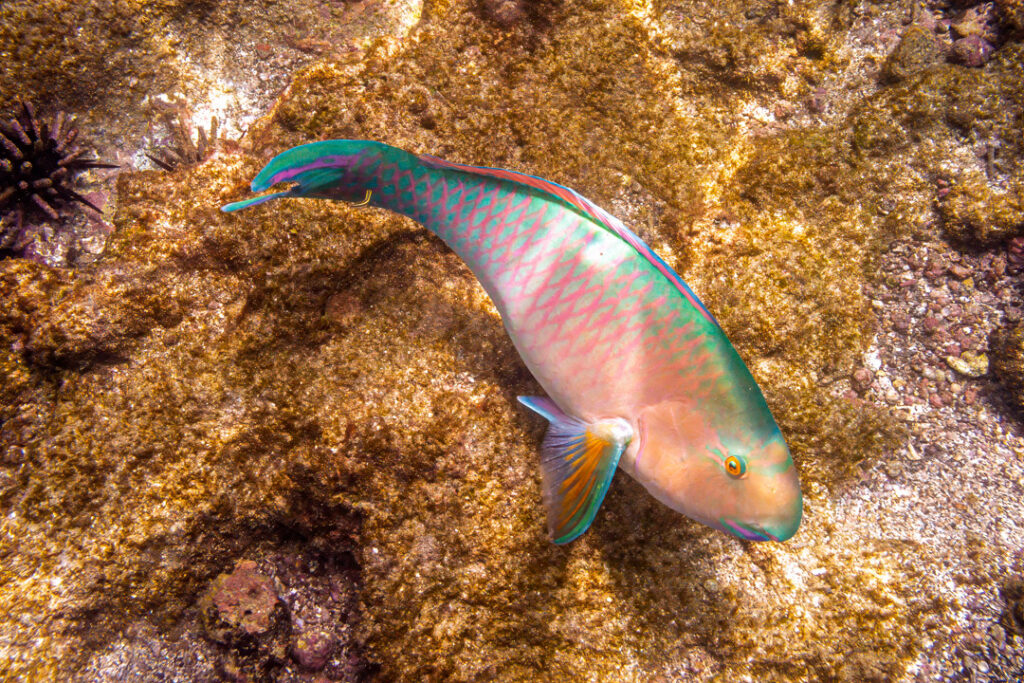
Snorkelers in the crystal-clear water are treated to an abundance of brilliantly colored fish, sea turtles, small sharks, and, if they are lucky, a marine iguana, all set against a backdrop of rugged coral reefs. The experience gave a whole new meaning to Clemenza’s description of Luca Brasi’s fate in The Godfather, “sleeping with the fishes.”
Air. On every island, there is a plethora of birds, and I got so close to the Blue-Footed Boobies and their decorative “paint” that I could make the famous naturalist David Attenborough green with envy.
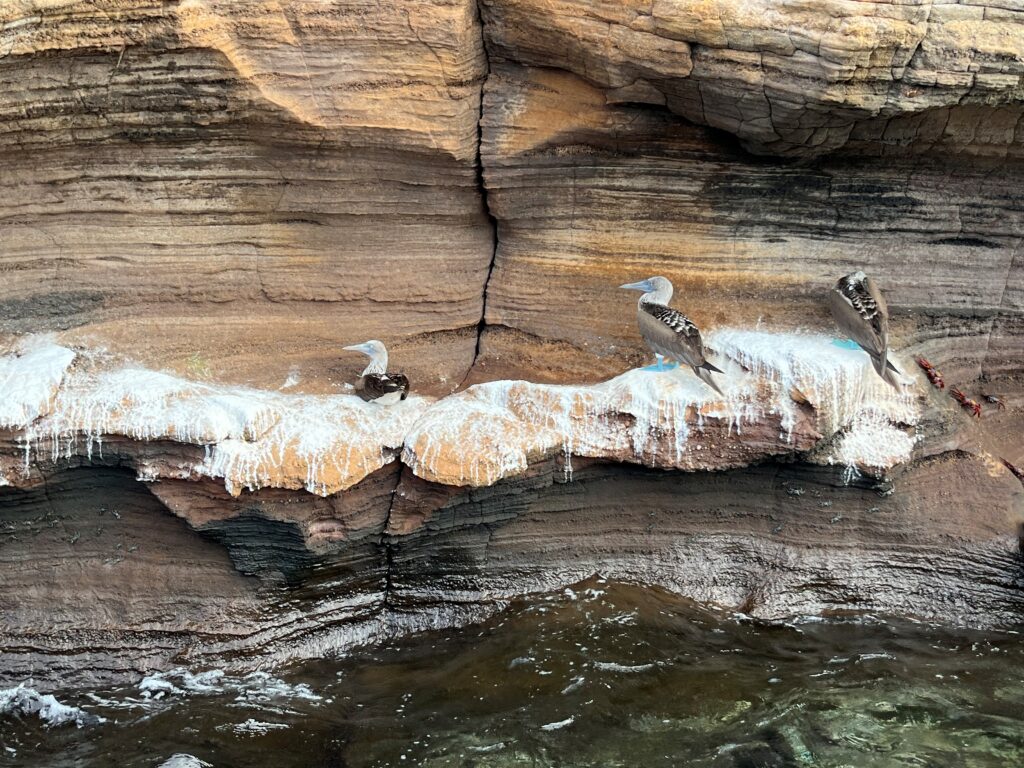
With no land-based predators, the bird population on Genovesa Island, including 200,000 Red-Footed Boobies, resembles Alfred Hitchcock’s Birds or a mosquito swarm around the food at your July 4th picnic. Perhaps you could find the same density of boobies only in a misnamed gentlemen’s club.
Again, these birds showed no fear of humans. We walked along a trail, sometimes less than two feet from where they were nesting. Once, a bird lounging on the footpath refused to yield as we walked by, less than a foot away.
________________________________________________
Alas, for the first time in 175+ posts, I have exceeded my self-imposed word count, and there is still much more that could be written. You must resort to the World Wide Web to fill in the gaps. Next week, a message about Peru!